
 |
New Music Co-op GuidelinesTable of Contents
IntroductionAmong our common goals are: to increase the awareness and understanding of new music among local composers, performers, and audiences; to support and present a wide variety of innovative and compelling new works; and to foster a unified vision of artistic development in the community. Among the advantages for the community are: more performance opportunities for new creative music and musicians; more resources for organizers interested in presenting ideas; and a nurturing environment for the development of concepts and ideas. Some of the ideas behind this way of working come from models for non-hierarchical communities. It is important to remember that these concepts do not prohibit members from taking leadership roles; in fact, they encourage all members to do so. Formal ConsensusIn the course of getting things done as the New Music Co-op, we will inevitably need to come to decisions for the group. Decisions surrounding performances, membership, and group activities affect all members. Methods of decision making can range from one person having total authority to all members sharing power and responsibility. Formal consensus is a method in which every person who is affected by a decision is involved in the decision-making process. Likewise, each person has the responsibility to actively participate as a creative individual within the group's structure. When everyone participates, ideas build upon each other and creative interplay results. Like any process, Formal Consensus can be inefficient if a group does not first agree to follow a particular structure. The handbook on Formal Consensus http://www.ic.org/pnp/ocac/ offers guidelines and formats for managing meetings, facilitating discussions, resolving conflict, and reaching decisions. By using this process, members of the group should be able to reach decisions creatively and efficiently. MembershipMembership in the Co-op should remain open in order to encourage growth in the group. However, it is in the best interest of the group for members to have a say in how the group grows. Any potential member interested in joining the Co-op should attend one of the monthly meetings in order to meet the group. Once they have done this, any current member can propose their membership during a meeting. The proposing member should present the proposed member (in their absence) as a valuable addition to the group. The group should then attempt to consense on the addition of that member. Most of the time, this will be a very simple and quick process with little discussion. Note: Any non-member can participate in projects and performances if the organizer of a project chooses to include them. There are no membership dues. MeetingsA meeting to discuss issues pertaining to the entire group should be held monthly. Initially, this meeting would be on the first Tuesday of every month, but the date may be changed by consensus. Meetings are conducted by a facilitator. The facilitator handles organizational issues like the agenda and the stack. At the end of each meeting, the facilitator for the next meeting is decided upon. Meetings are open to all, member or guest. This allows potential members to observe and interact with the group. Non-members, however, are never involved in the consensus process of decision making. An agenda for the meeting should be set and sent out by the facilitator at least two days in advance of the meeting. The agenda should include items such as:
It is the responsibility of each member to familiarize him/herself with the agenda and proposal material before each meeting. Participants who may not be able to attend the meeting are encouraged to send business and concerns with a representative, but cannot participate in the consensus process while absent. Minutes from the meeting will be taken and mailed to all members. Project ProposalsAlthough many proposals will be for performances, they may also be for workshops, outreach activities, collaborations with other groups, etc. Proposals may be made by any member. The proposer should send finalized proposals to all Co-op members for review via e-mail one week before each meeting. If their idea is selected by the group, the proposer should be prepared to take a leadership role within the group while their project is being realized. An initial performance proposal should include:
During the meeting, the above items may be discussed and modified through the consensus process. Additional items to be addressed in the meeting are as follows:
There is a potential for the group to have more acceptable proposals on the table than it has time or resources. In that case, it may be necessary to combine projects, table one for future consideration, or schedule far in the future. If resources are available, parallel projects should be encouraged. Steps a proposal might go through:1. Initial presentation and descriptionThis involves the proposer pitching the idea to the group. Here, the proposer has a chance to get people excited and bring up issues with which they might be struggling in the development of the idea. 2. Call for consensus on viability of projectBefore further development begins, members should consense on the viability of the project. This should weed out any ideas that the group feels go against the interests or direction of the organization. It also gives the proposer a chance to defend the idea. This should be a time-limited discussion. The end result of this discussion should be one of the following: a. Consensus to continue with development. This could include a list of issues to be resolved in committee. Some of these issues may be flagged as crucial to the success of the project, in which case final acceptance of the proposal would be tabled until the next meeting. b. Declaration of a block by one or more members of the group. The proposer is welcome to re-work the proposal with the issues behind the block in mind. In this case, the proposer would present again at a later meeting. The members declaring a block should be encouraged to participate in the resolution of outstanding issues before the next meeting. 3. A call for participants/volunteersIf the project is to undergo further development, the proposer may choose to gather a small committee together to oversee its development. This committee might be comprised of two or more people chosen by the group leader depending on the scope of the project. The project committee may also use the consensus to make decisions. The project may also require a number of non-member participants, including people to promote, design flyers, schedule rehearsals, etc. Options for filling the project's required roles should be briefly discussed at the meeting. 4. Summary of project issues and timeline for developmentAt this point any outstanding issues should be restated, including tasks for the project committee to complete before the general meeting. A project committee meeting may also be scheduled at this time. "Clarifying" Diagram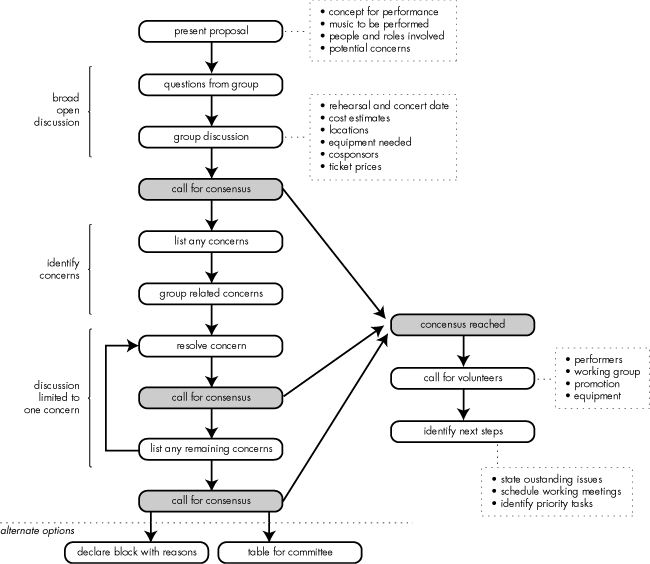
|
|
|
|
||
|
|||||